One Set of Frameworks, Two Diagnostic Products

Kauli and Matrix are two AI-native products I designed and built solo under Suluhu Studio, both using the Claude API. They look like separate tools, a decision diagnostic and an organizational maturity assessment, but they run on the same underlying frameworks pointed at two different targets: one decision at a time, or a whole design function at once.

Role

Founder & Design Lead

Industry

Technology

Year

2026

person writing on white paper

The shared frameworks

Both products are built on three diagnostic lenses I developed for Suluhu's client work before either product existed: Build Threshold, for a decision under pressure to commit, which tests whether the conditions required to proceed are actually met or only assumed to be. Friction Map, for something already underperforming, which locates where resistance is concentrated before anyone designs a fix. Signal Stack, for a founder sitting on conflicting data, which separates what's actually known from what's being assumed.

Kauli applies these three frameworks directly to a founder's stated decision. Matrix uses one of them, Friction Map, internally, as the logic that decides which two interventions would move an organization's design function the most. Building the frameworks once and reusing them across two products wasn't the plan from the start, it's what happened once I'd built Kauli and then needed a way to prioritize interventions inside Matrix, and Friction Map was already the right shape for that problem.

The shared frameworks

Both products are built on three diagnostic lenses I developed for Suluhu's client work before either product existed: Build Threshold, for a decision under pressure to commit, which tests whether the conditions required to proceed are actually met or only assumed to be. Friction Map, for something already underperforming, which locates where resistance is concentrated before anyone designs a fix. Signal Stack, for a founder sitting on conflicting data, which separates what's actually known from what's being assumed.

Kauli applies these three frameworks directly to a founder's stated decision. Matrix uses one of them, Friction Map, internally, as the logic that decides which two interventions would move an organization's design function the most. Building the frameworks once and reusing them across two products wasn't the plan from the start, it's what happened once I'd built Kauli and then needed a way to prioritize interventions inside Matrix, and Friction Map was already the right shape for that problem.

Kauli: diagnosing a single decision

Kauli is a 20-minute, no-login self-serve tool. A founder describes their organization and the decision in front of them, Kauli selects the right framework based on where the decision actually sits, and runs a structured interrogation, not a form. It won't accept "we need to redesign our onboarding" as a decision brief, since that's a solution wearing a problem's clothes, and it pushes back on thin answers rather than letting them through. The output names the real decision, the framework applied, why that framework and not the other two, and the two structural findings a founder was least likely to have already seen themselves.

You can try out Kauli for your organization here.
Matrix: diagnosing a whole design function

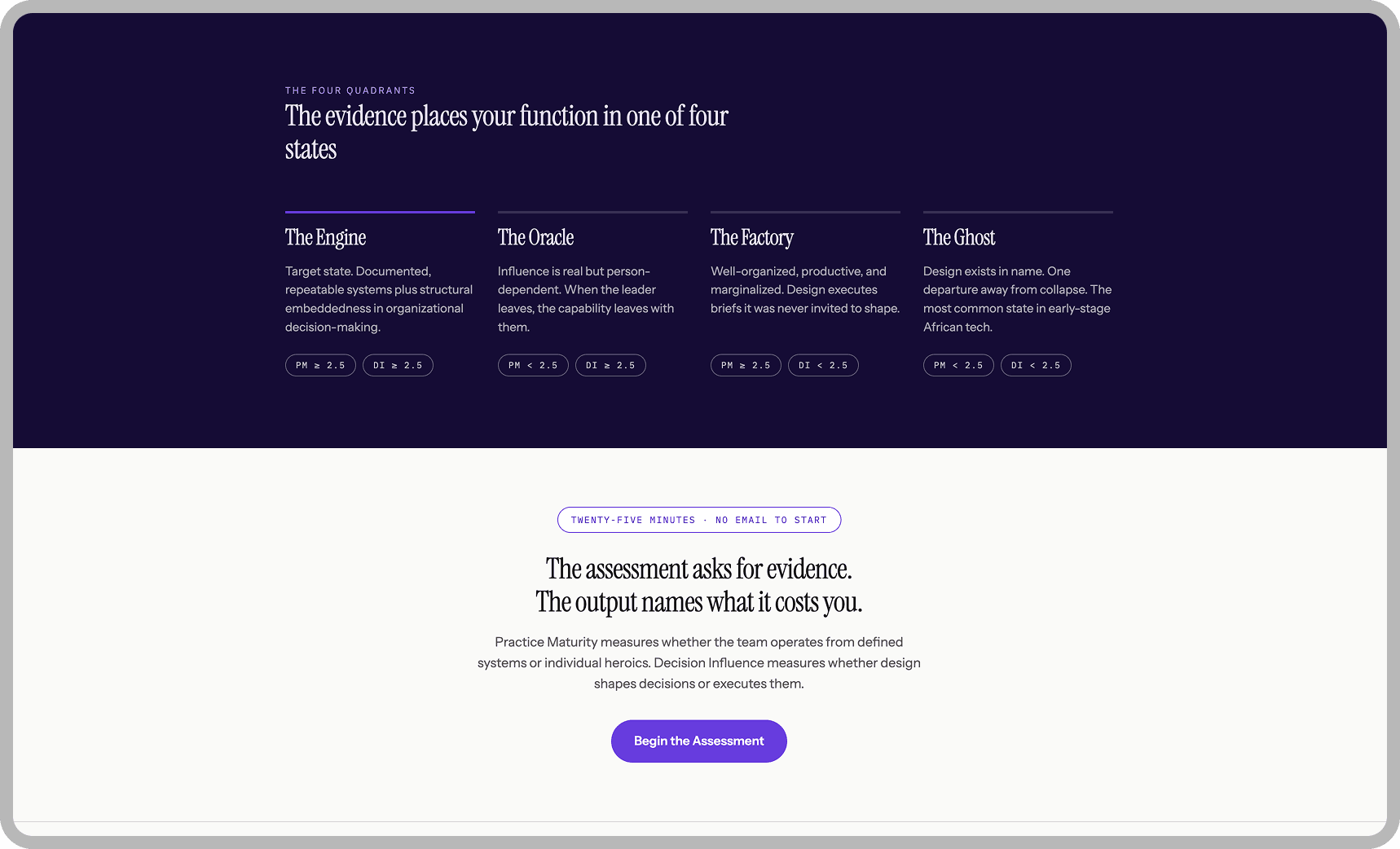
Matrix asks a different question: not whether one decision is sound, but whether a design function itself is built to last and actually shapes what an organization decides. Most existing design maturity models, including the well-known Western ones, measure process sophistication as a stand-in for organizational value. I built Matrix around a different premise, that a design function needs to satisfy two separate conditions to be genuinely mature: whether its practices are documented and would survive a key person leaving, and whether it actually changes the decisions the organization makes, not just how those decisions get executed. A team can be highly disciplined and still be organizationally invisible. A team can have real influence and still be one departure away from losing it. Matrix measures both conditions independently, because neither one alone tells you whether the function is actually healthy.

The assessment scores across five dimensions, covering process architecture, research and evidence, business articulation, organizational integration, and scalability and succession, and produces one of four named diagnostic outcomes describing the specific structural condition the function is in and what kind of intervention it actually needs, not a generic maturity score.

Matrix runs in two modes: a self-serve AI-scored version, and a fuller version I administer personally as part of Suluhu's Design Intelligence in Residence engagement. It's currently on its second version, revised since the first went into use.

You can try out Matrix for your organization here.

Matrix: diagnosing a whole design function

Matrix asks a different question: not whether one decision is sound, but whether a design function itself is built to last and actually shapes what an organization decides. Most existing design maturity models, including the well-known Western ones, measure process sophistication as a stand-in for organizational value. I built Matrix around a different premise, that a design function needs to satisfy two separate conditions to be genuinely mature: whether its practices are documented and would survive a key person leaving, and whether it actually changes the decisions the organization makes, not just how those decisions get executed. A team can be highly disciplined and still be organizationally invisible. A team can have real influence and still be one departure away from losing it. Matrix measures both conditions independently, because neither one alone tells you whether the function is actually healthy.

The assessment scores across five dimensions, covering process architecture, research and evidence, business articulation, organizational integration, and scalability and succession, and produces one of four named diagnostic outcomes describing the specific structural condition the function is in and what kind of intervention it actually needs, not a generic maturity score.

Matrix runs in two modes: a self-serve AI-scored version, and a fuller version I administer personally as part of Suluhu's Design Intelligence in Residence engagement. It's currently on its second version, revised since the first went into use.

You can try out Matrix for your organization here.

Other projects

Copyright 2026 — Rey Mungai

Copyright 2026 — Rey Mungai

Copyright 2026 — Rey Mungai

Create a free website with Framer, the website builder loved by startups, designers and agencies.